Tuesday, December 21, 2021

Cloud Cuckoo Land, by Anthony Doerr: Stories Are Timeless

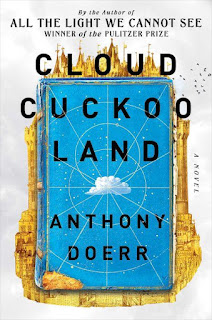
They used to say that when writers are out of ideas, they write about writers. These days, however, it seems like when writers are out of ideas (or just want to pander to readers) they write about books, or the power of storytelling, or the importance of literature, etc., etc. I'm mostly here for it. But it's not always completely successful.

To wit, I give you this lukewarm review of Anthony Doerr's much heralded new novel, Cloud Cuckoo Land. It's, you know, fine. But it's a long, needlessly complicated, questionably structured journey to arrive at the point: Stories are timeless.

So Cloud Cuckoo Land is three stories in one, and it's like Doerr put them all in a blender and then drizzled parts of each out onto the page. There's a story told from both sides of the siege of Constantinople in 1452. There's a modern-times story of a Korean War veteran directing a play in a library and an eco-terrorist who is planning to bomb the real estate company next door. And then there's the pre-teen girl hurtling through space on a space ship several centuries in the future, presumably escaping a destroyed Earth, and along with her shipmates, hoping to restart human civilization on a distant planet.

For the first half or so of the novel, I was enthralled, and the structure of skipping back and forth between these stories, seemed to work fine. But then I got tired of it because I couldn't figure out the why. Why was it necessary that each of these stories needed to keep interrupting the others. Each story builds drama, but then we're whisked off to the others. And once we start to see their central point of converge, frankly it's a bit of a letdown. The stories seem to collapse under their own weight of expectation. 

I started this book hoping for a David Mitchell-esque display of storytelling. And the premise and structure are certainly inventive and imaginative. I just wasn't sure Doerr landed it all successfully. I'm certainly in the minority in this somewhat tepid opinion, because this has landed on many "favorites of 2021" lists. But to me, it just didn't quite deliver on what it promised.

(Side note: This book is listed at 620+ pages. It's maaaaayyyybe 450. There are tons of chapter breaks and blanks pages. And this bugged me to no end, I'm not sure why. Like the publisher wanted to make the book feel more substantial than it is.)

Thursday, December 16, 2021

The New Dork Review's Top 10 Books of 2021

On the cusp of 2022, we're still feeling the effects of 2020. But in 2021, at least in terms of books, that was mainly a good thing. Because many 2020 releases were delayed due to the pandemic, 2021 was quite the embarrassment of riches for new novels. Every week, as we put out the new releases at RoscoeBooks, we were astounded at not just the number of new releases, but the number of big-name authors (especially this fall) who published books this year. It was truly an amazing book year. 

Even so, I actually read less this year than any in the last 10 or so (around 60 total books and about 23,000 pages). I'm not sure why, it just happened that way. But I still read a ton of amazing books. And actually posted here more than any year since 2015. So that's a plus!

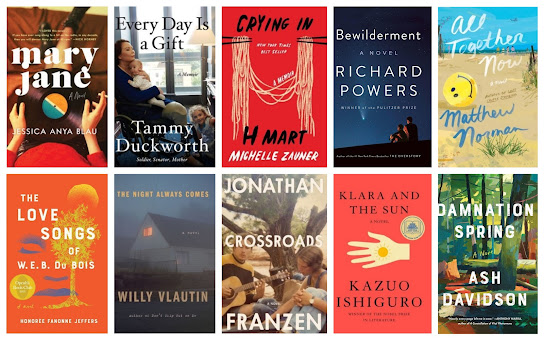
And but so, here are my top 10 favorite books of the year. These are in no particular order, except for No. 1. Since I read it this summer, Damnation Spring has been my no-hesitation answer for favorite book of the year. And it still is.

10. Mary Jane, by Jessica Anya Blau — Rock stars: They're just like us. Only waaaaaay cooler. Of any novel I read this year, I think this one surprised me most for how much I loved it. Yes, the "Almost Famous" comparisons are apt, but that's only one of about 10 reasons this novel is fantastic. One of my favorite parts of this novel is the coming-of-age aspect: How Mary Jane reacts when she collides with new ideas and new ways of thinking.

9. Every Day Is A Gift, by Tammy Duckworth — If you thought a memoir about a woman losing her legs in a helicopter crash couldn't also be freakin' hilarious, well, then please meet Tammy Duckworth. I was a huge fan of hers before, but after reading this, I'm in total awe of her. Truly inspirational! And she'll be the first to tell you, she has a lot of work left to do.

8. Crying In H Mart, by Michelle Zauner — This is the second year in a row I've had a musician's memoir in my top 10 (last year was Mikel Jollet's Hollywood Park), and in both cases, the book itself was barely about music. Zauner writes about her often fraught relationship with her mother, her Korean heritage and her attempt to reconnect with it through food, and her grief from her mother's death. Her prose here is clear, precise, and powerful. I fancy myself pretty knowledgable about music, but I had never heard of Japanese Breakfast before reading this memoir. Do yourself a favor, and check out the band's most recent album, which is sort of a companion to this book — it's really great, and of course this book is, too.

7. Bewilderment, by Richard Powers — This novel has more than a little in common with No. 1 on my list, and continues a recent trend in publishing, which I am completely here for: Novels with a decidedly environmentalist bent. This story of a father and his son also has a lot in common with No. 2 on my list below: It's a lesson in empathy. Both of these qualities add up to a richly rewarding reading experience, which, if you've read Powers before, you know is par for the course with him. 

6. All Together Now, by Matthew Norman — This quintessential summer novel doubles as a near-perfect "old friends reunion" novel. Matthew Norman is a must-read for me whenever he publishes, and thankfully, he writes quickly. This, his fourth novel, is my favorite of his. Jonathan Tropper, my erstwhile favorite "dude lit" writer, hasn't published anything in 10 years (he's busy writing TV), so I'm thankful Norman has stepped in to fill the void. But with this novel, Norman definitely moves beyond the traditional dude lit. This one's got all kind of heart, and more than a few twists and turns.

5. The Love Songs of W.E.B Dubois, by Honoree Fanonne Jeffers — Full disclosure, I'm not yet finished with this 800-page novel. But I'm close enough to the end that I can confidently add it to this list. This is an epic story of a Black girl's coming of age in modern times, and also the fraught history of her family. Populated with several vivid and fascinating characters, this is a brick of a novel that's actually difficult to put down. 

4. The Night Always Comes, by Willy Vlautin — Something this short shouldn't be this powerful. It's almost too cliche to describe novels about poverty and drugs as "gritty," but this novel absolutely is. And it has such an air of authenticity. Just blew me away. 

3. Crossroads, by Jonathan Franzen — Of course, The Franzen would make the list. But I'm not just fan-boying by myself over here. Many readers I've talked to have lauded this book as a huge step forward for an already incredibly accomplished novelist. And as the first in a trilogy, it's exciting to be able to look forward to seeing these characters again down the road.

2. Klara and the Sun, by Kazuo Ishiguro — What a gift for readers that a current Nobel laureate is still publishing terrific novels. We have so much to learn from Ishiguro's books, and as with all Ishiguro's stories, he uses parable to make complex ideas simpler, but incredibly profound. Here, a robot teaches us a master class in empathy. 

1. Damnation Spring, by Ash Davidson —Damn. Damn. Damn. This is sooooo freakin' good. I loved every second I spent with this book, even with some pretty harrowing plot twists. I cared about these characters so much. It's a truly great American novel. 

Thursday, December 2, 2021

Abundance, by Jakob Guanzon: Devastating Depiction of American Poverty

I remember reading an article awhile back in which people who had grown up poor discussed things that, to them, made other people seem rich. One that was really eye-opening to me is that "rich" people don't know exactly how much money they have at any given time. Jakob Guanzon's devastating novel, Abundance, really hammers that point home, as he each chapter in this novel is literally titled with the precise amount of money our protagonist Henry has.

But as jolting as that idea is to explain the difference between the haves and have-nots, Guanzon provides one that's even more profound. As Henry is working a difficult job at a rich person's house, Henry's coworker disdainfully says: "Imagine having enough money to trust people." That line, too, just blew my mind. Imagine. 

So this is a novel about the failing American dream, poverty and lost dignity, about drug addiction, and about compounding bad circumstances with even worse decisions.

The story here is about a young man named Henry, whose parents have died, left him with a mountain of debt, and he has no real opportunities to make his life better. He's spent time in a drug rehab facility as a teenager, where he meets Michelle, the eventual mother of his child, Junior. Henry and Michelle reconnect after rehab and fall in love. But struggle. And Henry gets mixed up in a drug scheme with a shady guy named Al, which eventually results in jail time. When he gets out, nothing is the same. His son doesn't recognize him and his wife hates him. 

This is all told in flashback chapters. In real-time, Michelle has left, and Henry and Junior are living in his truck. But today, it's Junior's birthday and Henry has a few bucks in his pocket which he's going to use to splurge on a hotel room for the night. And he has a scheduled job interview the next day. Things might be looking up. But will Henry finally be able to pull it together? Will he be able to regain his dignity and the respect of his son? 

Henry is certainly not the heart-of-gold, pull-yourself-up-by-the-bootstraps protagonist you want him to be (he's certainly not Chris in The Pursuit of Happyness). But you still root for him, if for no other reason than how badly you feel for his young son. None of this is Junior's fault, and yet he's expected to maintain his stiff upper lip, live in a truck, go to school, and hope everything will eventually be okay. 

I loved this novel, even with an ending that didn't quite land right. Still, the writing here is true and clever and authentic. What a book. I'm glad the NBA longlist rescued this book from relative obscurity. Every American should read this novel. 

Thursday, November 18, 2021

The Lincoln Highway, by Amor Towles: Growing Pains, Trains, and Automobiles

I guess it makes sense that one of our best pure storytellers would get around to writing a story where the major through-line is storytelling. That's what we have here in Amor Towles' third novel, The Lincoln Highway. On the surface, this is part coming-of-age story and part PG version of On The Road. But really, it's an homage to how stories are constructed, told, read, and enjoyed. Stories are part myth, part fact, part-real life, part pure imagination. At least that's how they are in their ideal state. And Towles very much wants us to read The Lincoln Highway thusly.

It works. Of course it works. With a storyteller of Towles' caliber, it almost couldn't not work. But this is also a story that is sort of in love with its cleverness, its wholesomeness, and its penchant for winking at you, like your grandfather who has just slipped you a cookie before dinner. You may not think that's a bad thing. And I don't either, frankly. You'd have be a giant cynic to think those are bad qualities in a piece of literature. 

But as I am looking back on this novel, I can't quite put my finger on why I liked it, but didn't LIKE IT like it. I think maybe it's enjoying the wink so much that I'd almost have to close the covers and roll my eyes at it (behind its back of course, lest I hurt it's feeling!). Like it's almost too much. It is possible to have TOO many cookies before dinner.

Maybe all this is beside the point. Because really, this is just a rippin' good yarn. It's 1954, and 18-year-old Emmett and his curious, bookish little brother Billy, plan to head out from their failed Nebraska farm to find their mother in San Francisco. Their father has just died, and Emmett has just been released from a stint in juvie after he punched a kid for insulting his family (the kid died when he fell and hit his head). But a couple of interlopers have stowed away in Emmett's ride back to his farm and now insinuated themselves into Emmett's plans. Woolly and Duchess have their own plan: Borrow Emmett's car, drive to upstate New York, and recover a $150,000 trust fund Woolly's rich family has left him. 

Emmett wants no part in this scheme. But when the two "borrow" his car, he and Billy have no choice but to head east to try to recover it. Adventure, a wide cast of characters, and a novel brimming with almost kitschy Americana ensues.

So even though I felt like a little something was missing that would've moved this novel over the good-to-great hump, I still thoroughly enjoyed reading it. To read Amor Towles is to be as delighted reading as he seems to be writing. To me, this was more in the category of his first novel, Rules of Civility than his brilliant and massively successful second novel, A Gentleman In Moscow. But overall, I think readers generally and Towles fans specifically will be more than happy with this new novel.

Thursday, October 7, 2021

I Love You But I've Chosen Darkness, by Claire Vaye Watkins: Awesome Autofiction

So I don't mind admitting my superficiality: I read Claire Vaye Watkins' new novel, I Love You But I've Chosen Darkness, based almost solely on its incredibly awesome title. Hey, there are a lot worse reasons to pick up a novel.

Here's how it started: 

Me, after about 10 pages: Ah, man is this gonna be just another one of these self-indulgent, self-important pieces of autofiction?

Here's how it's going: 

Me, halfway through, and riveted: Okay, yeah, it is, but it's also really good!

If you do some googling, you'll learn that the real-person writer Claire Vaye Watkins' father was one of Charles Manson's right-hand men. Which is crazy! This novel gives a long story about her/the narrator's parents, how they met, etc., right at the beginning. So right off the bad the autofiction/memoir line is a little blurred. In these autofiction novels that seem to be so trendy these days, you always wonder where the line between reality and fiction is, which I realize is not productive to your reading experience. But I can't help it. It sort of feels like you're being tricked a little, but not in a nefarious way. (Of course, to most writers, readers trying to figure out what's real and not is beside the point — and in fact, is probably supremely irritating to them.) 

Anyway, that line is further blurred because the rest of the novel is about a character named Claire Vaye Watkins (also a writer). The character Claire and her husband have just had a baby. And she has had enough — she feels trapped, confined, and felled by postpartum depression. 

When she travels to her hometown of Reno for an author event, she hangs out with some of her old friends, does mushrooms, and slowly realizes she can't go back to her former life. So now what? That's what the rest of the novel is — her just trying (or not really trying, just drifting) to figure out her life. 

All the while, she contemplates a series of letters her mother, who has since died of an opioid overdose, wrote to a cousin when her mother was a teenager in Las Vegas in the 1970s. These letters are give us breaks in the narrator's story. And part of the point is: The apple maybe hasn't fallen far from the tree.

Yes, so once you get past trying to figure out what's fiction and not, you'll find a really sharply written story about returning to your roots. When you start slowly deviating from who you think you are, how do you get back to who you want yourself to be? 

I enjoyed this — a lot more than I thought I might after the first few pages. It's an acutely observed, quickly paced, clever, often funny, often VERY raunchy, and really entertaining read.