Thursday, January 19, 2023

The Last Chairlift, by John Irving: A Test of Endurance

Last week, after nearly three months of reading John Irving's mammoth 900-page novel The Last Chairlift a few pages a day, I texted a friend: "I have 75 pages to go, and it feels like Mile 23 of a marathon. I'm going to make it, but it hurts!"

That's probably overly dramatic. There's plenty to like here. It's one of those novels you'll read five pages and wonder why you're reading this or ever liked John Irving or like reading at all, and then he'll drop some wisdom or a plot twist or a perfect sentence and you realize why you love all those things. 

The Last Chairlift covers 80 years in the life of one Adam Brewster, a New England writer who grows up with a lesbian mother, a trans stepfather, and is surrounded by a cast of characters that let's just say wouldn't exactly be welcomed at a Waffle House in a red state. They're a fascinating group, to say the least. 

In an interview with Seth Meyers not long after the book was published, Irving explained why it was important to make Adam, the straight, white male character, the outsider in this group of characters. "It was certainly my intention to make him the odd guy out, to make him the 'queer' member of the family -- queer in the sense of strange and not up to speed." I loved that! Good fiction turns norms on their head. 

As with many of Irving's novels, he repeats a single phrase over and over throughout a novel to really drive home a theme. Here, Adam, who is telling this story in the first-person, tells us often the best advice he ever received, and the best lesson he ever learned: "There's more than one way to love people." 

In total, the novel is a career retrospective for Irving, who has said this will be his last "long" novel. There's wrestling and uncomfortable situations with young men and much older women and progressive politics and lots of writers and yes, ghosts.

When I finished the book, I texted my friend again "FINISHED!" She asked if it was worth it, and I had to think about that a minute. Yes, it's definitely always worth it to finish a novel, I responded. This one tested me for sure. But ultimately, yes, it was worth it. It did hurt at times, but also like a marathon, I knew I was signing up for pain when I started this, and finishing it did feel like an accomplishment!

I've read nearly every word Irving has written, and I'd put this one in the bottom of the middle-third of his work. It's definitely better than Avenue of Mysteries and Until I Find You, but nowhere near Garp or Owen Meany. 

Tuesday, January 17, 2023

The Seven Moons of Maali Almeida, by Shehan Karunatilaka: War, Humans Are Absurd

If you read only one Sri Lankan novel this year, let this be it. Here's a quick syllogism to summarize The Seven Moons of Maali Almeida, the 2022 Booker Prize winner: War is hell. Humans create war. Therefore, humans are hell. 

Maali Almeida, a Sri Lankan photographer who takes pictures of atrocities committed during the Sri Lankan civil war, wakes up dead. He doesn't know how or why he died, but he comes to understand he's stuck in the In Between, has seven moons to get his affairs back on Earth in order, and move to The Light. 

His affairs include some spicy photographs that expose some corruption on all sides of the horrific war. He's hidden the negatives and has to find a way to communicate to his former boyfriend DD and best friend Jaki so that they can publish the photos and expose the bad actors who are basically using the horrors of war for personal benefit. (I think -- frankly, this book was a little hard to follow at times, but that's the gist.)

But that short description belies the originality of this novel. Would you believe this novel's also hilarious? Maali is a goofy, irreverent knockabout, even in the afterlife. He spent most of his time alive fooling around with as many dudes as he could, drinking and gambling his meager earnings away, and generally not caring about much except his own self. 

Now that he's arrived in the afterlife, will he learn a lesson? Can he still do some good? 

This novel is an amazing feat of art -- the funniest war novel I've ever read since Catch-22. But it's also furious and profound about the absurdity of war and how terrible humans can be. "Do animals get an afterlife?" Karunatilaka writes. "Or is their punishment to be reborn as humans?" Near the end of the novel, title character Maali has a conversation with a leopard who wants to be human. The leopard says: "I can't understand why humans destroy when they can create. Such a waste."

Such a waste, indeed.

Tuesday, December 6, 2022

The New Dork Review of Books Top 10 of 2022

Mirroring Christmas creep, it feels like these "favorites of the year" lists are coming out earlier and earlier. I'm already like three weeks late and this is the earliest I've ever finished this post! 

Speaking of trends, exactly half of this year's list is made up of novels either set in Chicago, by Chicago writers, or both. It was a banner literary year in the City of Broad Shoulders...and beyond. So here's this year's list, my 10 favorite books (in no particular order) of what was an incredible reading year.


10. Mount Chicago, by Adam Levin -- This novel is soooo damn funny. And infuriating. That's sort of Levin's schtick. He's the DFWest DFW since DFW DFWed. This is my favorite thing Levin's written.

9. Last Summer On State Street, by Toya Wolfe -- A fierce, stunning novel about a young girl growing up in Chicago's Robert Taylor Homes. I loved this book for its bravery. 

8. Marrying the Ketchups, by Jennifer Close -- Just pure fun. This novel is about a dysfunctional family and their dysfunctional love lives set against the backdrop of the 2016 Cubs, the horrific election that year, and a suburban restaurant. 

7. The Nineties, by Chuck Klosterman -- Required 2022 reading for Gen X. Klosterman brilliantly gives the best decade ever a fresh of coat of paint with the advantage of hindsight. The book helps you see the everything from Nirvana to Biodome 2 with clear eyes. 

6. Sea of Tranquility, by Emily St. John Mandel -- Definitely my favorite novel of the year partially taking place on a moon colony in the 2200s. There is an enormous amount of plot -- and thought-provocation (Are we IN A SIMULATION?) -- in a slim novel. 

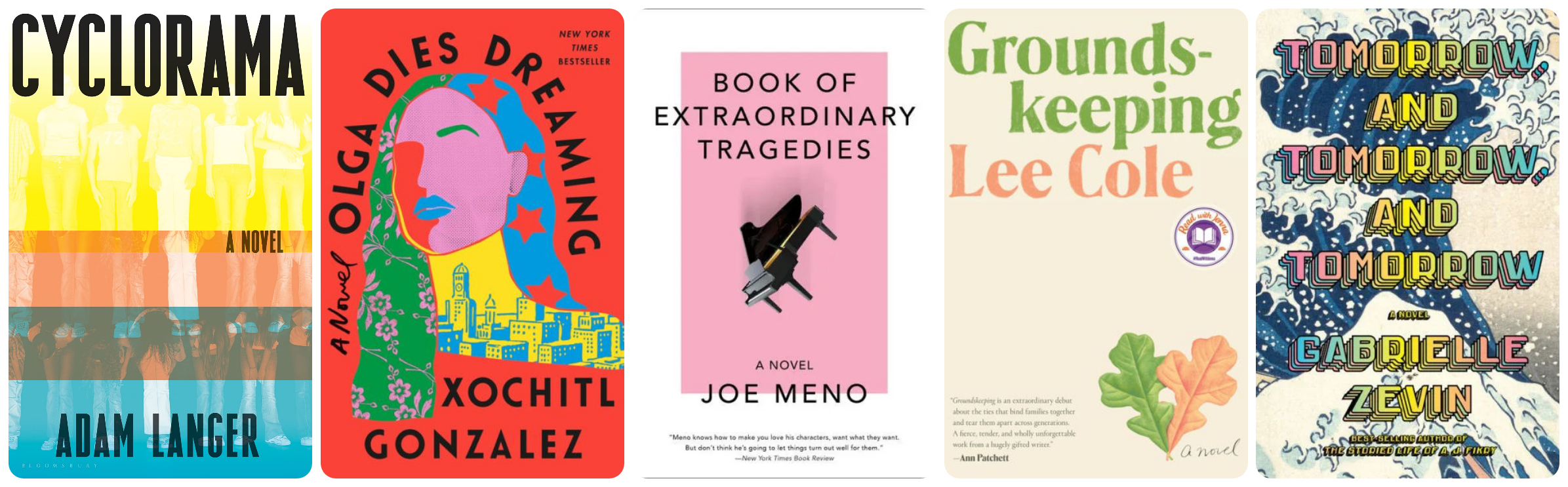
5. Cyclorama, by Adam Langer -- Another Chicago novel that explores whether people are basically good, the consequences of history repeating itself, and about choices made during our carefree youths potentially haunting our adulthood. Smart and immensely entertaining.

4. Olga Dies Dreaming, by Xochitl Gonzalez -- One of the first novels I read in 2022, I immediately knew this story about a Puerto Rican wedding planner in NYC would wind up on this list. What starts as a frothy novel about NYC's upper crust switches to very much a political novel about Puerto Rico. It's hard to believe this confident, accomplished novel is a debut!

3. Book of Extraordinary Tragedies, by Joe Meno -- Family will find a way, is what this terrific novel from one of my favorite writers is about. This is an odd takeaway, I realize, but I loved this book in part for how accurately Meno captures the gloom of Chicago winter in this novel. 

2. Groundskeeping, by Lee Cole -- This book wasn't written just for me, obviously. But it's one of those rare novels that felt like it was. A love story, campus novel, and examination of politics all in one. Wheelhouse. Book. Loved. It. 

1. Tomorrow, and Tomorrow, and Tomorrow, by Gabrielle Zevin -- This is this year's "Gee Greg, way to go out on a limb" pick. Yes, everyone loved this book, and everyone is right. 

Tuesday, October 18, 2022

Mount Chicago, by Adam Levin: One of the Funniest Novels I've Ever Read

I have some questions for you, Mr. Levin. You're a very good writer. You KNOW you're a very good writer. You're also a very self-aware writer. So when you're as good a writer as you are, and you fully understand what you're doing and its effect on your reader as well as you do, why do you insist on aggravating your reader just to the point where he wants to throw your novel across the goddamn room? Why? Why why why why why? 

Is it because it helps the other 90 percent of the novel, which is truly a marvel, stand out in even more stark relief? Is it because you're just a prankster? Do you just like keeping your readers on their toes, making sure they're paying attention? Or is it because you truly like to inflict a small measure of pain on people?

It doesn't matter. I'll still read every damn word you ever write if the remaining words you write in your career are even one-third as f#%king incredible as the good 90 percent of Mount Chicago. 

To my readers, most of whom I've probably already lost: Mount Chicago is one of the funniest novels I've ever read. That's the first time I've ever bolded a sentence in a review. Because that's really the one thing you need to know about this book. And when you consider it's sort of kind of tangentially about a massive tragedy that kills thousands of people, that's a pretty neat trick. And that's not the only trick. There's no line between author and novel here. As the kids say, so meta. Except maybe there is a line? Who knows? I'm not smart enough to try to figure that out. And I don't think Adam Levin wants you try. 

To describe it further, and I fully realize this is an absolutely ridiculous analogy, and I have no doubt Adam Levin would hate this, but this is my small measure of payback for making me read pages and pages about behavioral psychology and parrots and that really, really long duck (yes, duck) joke: Mount Chicago is what would happen if Kurt Vonnegut on speed, a baked and giggly Philip Roth (can you imagine?!), and David Foster Wallace on...well, no, just normal DFW...had a book baby. 

I can't find the passage or the interview now, and maybe I'm imagining this but, I think DFW said something really smart once about reader aggravation: That a good novel must have parts that aggravate the reader, but a good novelist knows just the right amount to antagonize his reader before he can pull back just in time, and entertain again. And so if you think about it, this novel's 575 pages, so 90 percent (again, my approximation for the non-purposefully-aggravating parts) of 575 is 517.5 INCREDIBLE pages. I like those odds. You probably skim over - whether on purpose or because you drift - 10 percent of every novel you read anyway, right?!

All right, so anyway: I loved this book. Absolutely loved it. You don't need to know what it's about, you can read that anywhere. But whatever you read that it's about, it's actually about Entourage (the HBO show) and metafiction and Chicago politics and psychology and cryptocurrency and other get-rich-quick-scams and the author's face and stand-up comedy and writing and depression and tragedy and love and coming-of-age and parrots. 

READ THIS. 

Thursday, October 13, 2022

Our Missing Hearts, by Celeste Ng: About An All-Too-Terrifyingly-Real Dystopian America

By the standard definition of dystopia -- an imagined state or society where there is great suffering or injustice -- Celeste Ng's new novel Our Missing Hearts is DEFINITELY set in a dystopian America. What's most terrifying -- and what makes this such an engaging read -- is that it's not at all hard to imagine this dystopian version of America becoming reality very soon. 

Ng's dystopian America, she tells us at the end, is based on real events -- violence against Asian Americans, freedoms curtailed in the name of "patriotism," even children being ripped away from their families. 

But there is cause for hope here: In this novel, librarians are heroes of the resistance. Stories and poetry and art still matter. And even as dire as things are, a small and dedicated group is still invested in fighting fascism, racism, and injustice. 

The story is about a 12-year-old boy named Bird. Bird's mother, a poet, has disappeared and Bird and his father, who works at a university library, have no clue what's happened to her. What we do know is that Bird's mother had published a poem that became, though it was not intended this way, a symbol of the resistance against a law known as PACT -- or Preserving American Cultures and Traditions. PACT was enacted after a years-long event known as the Crisis, which galvanized and basically codified burgeoning fascist, authoritarian, and horribly racist tendencies in America. Sound familiar? 

Bird begins finding some clues about his mother's whereabouts, and endeavors to find out what happened to her. And that's the meet of the novel: Will he find her? And will he discover why she disappeared?

I love Celeste Ng, and this is another terrific novel from her -- her first foray into what could be considered "speculative fiction." It's so beautifully written. And Ng truly understand compassion, family dynamics, loyalty, and heartbreak. She is absolutely a joy to read, even when this novel itself isn't exactly cheerful.