Friday, March 4, 2022

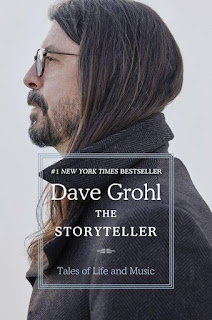
The Storyteller, by Dave Grohl: Genuine, Affable Man Loves Music

The Storyteller is an episodic memoir about Dave Grohl's life, his fascination with music, and his rise to become one of the more recognizable rock stars of all time. Yes, his time in Nirvana and his relationship with Kurt Cobain is in there, but it's not the focus. Rather, the focus is just how much Dave Grohl loves music. My favorite parts of the book are when he is assuring us how gobstopped he is to meet his musical idols, from Iggy Pop to Little Richard to AC/DC, even after he himself has achieved no small measure of fame. It's immensely relatable! 

Here's the thing about this book: If you didn’t know much at all about Dave Grohl, you’d probably read his book as, at best corny and at worst just god-awfully sappy. But instead, because it is Dave Grohl, and because we know music is quite literally his life and that he just seems like an affable, genuine dude, it's pretty easy to love this book. After all, it’s extremely difficult to be cynical about the writer of a book who himself seems to be the antithesis of cynical.

And the man sure can a tell a story! Grohl tells us he definitely wrote this book himself (no ghostwriter!). He explains that when everything shut down in March 2020, he nearly lost his mind because he missed the connections with people. And so he needed something to occupy his time while he couldn't play music. And I believe it! Some of the writing here is just so goofy and earnest, it couldn't have been written by anyone else but Grohl. Here, let me show you:

"I walk through this crazy life of a musician like a little boy in a museum surrounded by the exhibits I've spent a lifetime studying. And when I finally come face-to-face with someone who has inspired me along the way, I am thankful. I am grateful. And take none of it for granted. I am a firm believer in the shared humanity of music...I believe that people are inspired by people. That is why I feel the need to connect with my fans when they approach me. I'm a fan too."

I’ve seen Foo Fighters live twice, and both times they absolutely rocked the joint (the joint, in both cases, was the venerable Wrigley Field). One of those times was during the now-infamous “throne” tour in 2015 — Grohl was confined to a ridiculous throne he designed himself while on pain meds after he broke his leg falling off a stage in Sweden. Still rocked. He talks about this Wrigley show in the Conclusion of this book, and discusses how playing a show at a stadium across the street from where he saw his first ever show (Naked Raygun at Cubbie Bear in 1982) had brought his illustrious career full circle. 

I like Foo Fighters' music well enough, but I would never try to make an argument that they're in the top-tier of rock bands. Still, they're just a really good time. And that's the draw to see them live — or, as my friends are probably tired of hearing me say, I wish I loved anything as much as Dave Grohl loves playing music.

I greatly, greatly enjoyed this book. I mean, there's no way I wouldn't. And it's not just me: Literally every reader I've talked to who's read this has loved it too. You will not be disappointed! Remember: It's times like these we learn to live again.  

Monday, February 28, 2022

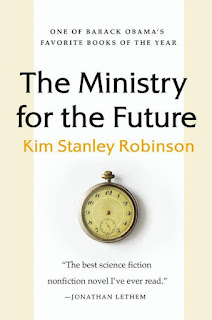
The Ministry for the Future, by Kim Stanley Robinson: How to Save the World in 108 Chapters

Rare is the cli-fi novel that is hopeful. But Kim Stanley Robinson's novel The Ministry for the Future actually is. Which is ironic given that the novel begins with a heat wave in India that kills 20 million people in one fell swoop. (If you're unfamiliar, "cli-fi" is shorthand for climate fiction, a new-ish genre whose popularity is growing in direct proportion to the worsening climate crisis.)

Imagine if death on that scale happened in the real world. How would we react? Would we finally change? That's where we start in this novel about what it'll take to stop climate change and, essentially, continue living on this planet. 

Our main character, as much as there is one, is a woman named Mary who has been tapped to lead the newly developed Ministry for the Future, headquartered in Zurich, Switzerland. It's 20-30 years in the future (from our present day) and this organization has been created by the signees of the Paris Climate Agreement to literally save the world. One of the very few people who survived the Indian heat wave, an American named Frank who had been there working for a relief organization, then seeks out Mary and to tell her his story and advocate for fast and far-reaching change. The two form an unlikely bond. 

But this plot is almost secondary to Robinson taking us through a litany of vignettes all over the world describing how people are experiencing the climate crisis (climate refugees, animal extinction, a flood in Los Angeles, and so many more). These set pieces show us the magnitude of the problem and how difficult the Ministry for the Future's task is. But through a combination of changes to the global banking system, some creative geoengineering, reforestation and re-wilding natural habitats, and even some rather nefarious tactics it'd be easy to label as eco-terrorism, change begins to happen.  

Robinson spares no detail in the explanations of these solutions, and it's mostly pretty interesting. But there are times it's a little dry, frankly — Robinson takes us deep into the weeds of global finance and economic theory. Also, there are (to me) pretty interminable descriptions of hiking expeditions in the Alps. And some of the little sections, like two told from the points of view of a photon and History, just feel a little off. 

But overall, it's a sobering, but illuminating and hopeful, view of what will need to happen to ensure we actually do have a future. In the real world, will we have the resolve to make these changes before it's too late?

Thursday, February 17, 2022

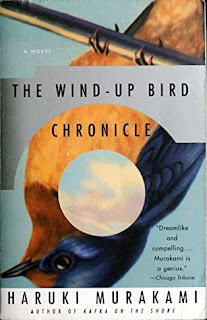
The Wind-Up Bird Chronicle, by Haruki Murakami: The Tale of Toru

I'm a huge Haruki Murakami fan. I love Norwegian Wood. I REALLY love Kafka On The Shore. I love a lot of his short fiction too, and I annoyingly foist What I Talk About When I Talk About Running on all my running friends. 

And so when you tell people you're a huge Haruki Murakami fan, they're always like, "But bro, have you even read The Wind-Up Bird Chronicle?" Until now, my answer was a sheepish no. But now I have! And I'm upset I put it off so long. It's freakin' brilliant.  

(Quick detour: Reading Murakami's opus gave me the occasion to revisit this post I wrote in 2011 about being a new Murakami fan. It cracked me up more than a little. I'm glad to see my stance on Amazon has remained consistent lo these 11 years. But my 11-years-ago self would be VERY disappointed in me if he knew it took me 11 years to finally get to Wind-Up Bird. Anyway, back to the post...)

The Wind-Up Bird Chronicle, if you're not familiar, is not about a bird (well, it's a little bit about a bird). But really, it's the story of a fellow named Toru Okada. (Toru is also the name of the narrator in Norwegian Wood, but that Toru is Toru Watanabe, so the Toru here is a different Toru. I think? But the fact that Murakami uses the same name is just another example of his unconventionality...or maybe it's a just an oversight? Or a coincidence? Or maybe it is the same person? Damn you, Murakami, for making me overthink everything! Or bless you, I'm not sure which.) 

So Toru is about as average as a guy can be. He's early 30s, a lawyer (though currently unemployed), married, and living a nice comfortable life. But then weird things start happening. People keep stopping by his house and telling him crazy stories —a guy tells him about his war experience in Manchuria, and a woman tells him about her experience as a prostitute.

And then his wife leaves him. And he spends some time in the bottom of a well contemplating life. And then his missing cat returns! And then things get even weirder. 

I mean, if you've read Murakami, you know that summarizing a plot is an exercise in futility. These novels have their own rules, their own logic, and occurrences and objects and dreams are symbols within metaphors wrapped in allusions. But then again, some things just are what they are (ie, sometimes the curtains were just f@$king blue, to recycle a meme I used writing about Kafka on the Shore.) 

Despite all that's going on here — fate vs. free will, the nature of reality, how we're connected to others, and so much more — this is a smooth, easy read. The No. 1 reason it took me so damn long to talk myself into reading this is that I had the (vastly mistaken) idea that Wind-Up Bird is difficult, a tough hang. It is not. It's a lot of fun. And I'd recommend it highly...whether or not you're an MFA bro. 

Thursday, February 10, 2022

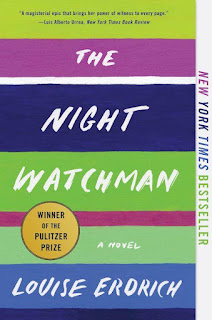
The Night Watchman, by Louise Erdrich: Poetic and Powerful

When an author as beloved as Louise Erdrich finally wins a Pulitzer, you read the book. You just do. But honestly, I put it off for a long time, and approached reading The Night Watchman like homework — something I felt like I should do, rather than something I really wanted to do. 

Erdrich quickly changed my mind. I was surprised how drawn I became to this book after only a few pages. Poetic and powerful, this is a fictional account of Erdrich's grandfather who fought to prevent the "termination" of North Dakota's Turtle Mountain Chippewas in 1952-53. A bill in Congress by a racist Mormon Senator sought to relocate them from their reservation and "reintegrate" or "assimilate" them into American society. "This new bill is about the worst thing for Indians to come down the pike," Erdrich's grandfather wrote in a letter, reproduced in the novel.

The novel is also the story of Patrice, a young woman who works at a factory on the reservation. Her story is about colliding with a changing world, looking for better opportunities, but still being comfortable with her heritage. Early in the story, Patrice has to travel to the Twin Cities to search for her sister Vera, who has disappeared. It's the first time Patrice has ever travelled, and been in a city, and it's eye-opening to her, but not necessarily in a good way.

For historical fiction, this is a surprisingly fluid, fast read. And I learned much. Very glad I read it.

Impressive side note: Erdrich is one of a handful of writers (I think just Philip Roth and John Updike are the other two, but I can't find a good source to confirm this) to win the hat-trick of major literary awards: Pulitzer (for this novel), the National Book Critics Circle Award (for LaRose), and the National Book Award (for The Round House). If you've never read her, this might be a good introduction to her fiction.

Friday, February 4, 2022

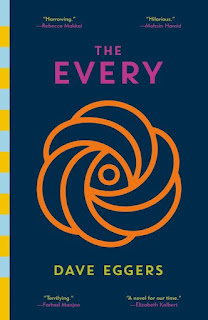
The Every, by Dave Eggers: The Tyranny of Choice

It's surely admirable that Dave Eggers isn't allowing his new novel to be sold on "the jungle," as he winkingly refers to Amazon in The Every. But unfortunately, the novel itself isn't nearly as good as his intentions. The Every is a sequel to Eggers' 2013 novel, The Circle —it actually feels like the second in a trilogy and has some serious Empire Strikes Back vibes. Here, the bad guys in the form of the evil tech company are winning. 

It's a few years in the future from the events of The Circle, and Eggers' Circle protagonist, Mae Holland, is now the CEO of the Every, which is a combination of the Circle and the newly acquired jungle. Our protagonist is a young woman from Idaho named Delaney, who together with her friend Wes, get jobs at The Every. But ever since Delaney recovered from a nasty screen addiction as a little girl, and "the jungle" destroyed her parents' grocery store, she's been hellbent on revenge against the evil tech company. 

Her plan is to destroy The Every from the inside out by introducing ridiculous idea after ridiculous idea until the public finally pushes back against the all-powerful tech company. Never mind that this premise, even for a satire, is patently silly, but my real beef is that the novel sort of just devolves into descriptions of these apps, and what happens when they're released into the wild. It just reads like a litany of bad ideas. For instance, Friendy is an app that allow you to gauge how good your friends really are by judging if they're being truthful to you in conversations, how much interaction you have with them, how emotionally fulfilling that interaction is, etc. Or OwnSelf, that tells you exactly when and for how long you should exercise, drink water, call you children, laugh, send out The Every's version of social media likes, and many more — basically controlling your entire life. And there are many, many more examples like this. 

Though it is a bit clumsy in its execution, and therefore doesn't quite work as satire, The Every is still an effective cautionary tale. Eggers hits on many of the same issues as in The Circle about the dangers of screen addiction, voluntarily relinquishing privacy, and choice. Of course, we all know that "slippery slope" is a logical fallacy. But slippery slope is also fertile ground for good satire. And though this isn't exactly good satire, the points are still well made. One of the main dangers introduced here is what happens when humans get lazy enough that they actually don't want choice. They want to be told want to do, have their lives planned out. The Every jumps on this notion and tries to pick the winners and losers. "Limitless choice is killing the world," one characters tells another.

The Every is also a novel about the dangers of group-think. Remember during 2016 how we just kept thinking the next horrific thing that presidential candidate said or did would be the one that finally caused his cult-like supporters to wise up and turn on him...but it never happened? That's what this novel is about too: Nothing is a bridge too far when it comes to group-think. 

On the plus side, I'll say this: Eggers is still very cool. There are several set pieces in this novel that had me howling — as on example, Delaney has to plan a "field trip" as a sort of welcome exercise. People keep asking the same questions over and over again, and are worried about the most ridiculous things. And then they all try to one-up each other in their outrage. It kind of reminded me of a neighborhood message board.

But these moments are too few, and The Every never really gains its footing like The Circle did, which felt clever and urgent. Often, The Every feels just ridiculous and too over-the-top. And it's also waaay too long. Eggers even makes a joke about how all novels should be fewer than 500 pages, and the absolutely limit of a reader's attention is 577, which is the exact folio count of The Every. But I'd humbly suggest The Every probably 177 pages too long. 

So even though I didn't think this was as successful as its predecessor, I'm hopeful for a satisfying Return-of-the-Jedi-esque conclusion to this trilogy. Eggers is still one of my favorites and I'll still read anything he writes. His heart is usually in the right place. And he usually and consistently makes me laugh, even if sometimes it's because it's ridiculous.