Thursday, February 17, 2022

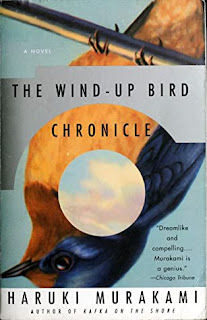
The Wind-Up Bird Chronicle, by Haruki Murakami: The Tale of Toru

I'm a huge Haruki Murakami fan. I love Norwegian Wood. I REALLY love Kafka On The Shore. I love a lot of his short fiction too, and I annoyingly foist What I Talk About When I Talk About Running on all my running friends. 

And so when you tell people you're a huge Haruki Murakami fan, they're always like, "But bro, have you even read The Wind-Up Bird Chronicle?" Until now, my answer was a sheepish no. But now I have! And I'm upset I put it off so long. It's freakin' brilliant.  

(Quick detour: Reading Murakami's opus gave me the occasion to revisit this post I wrote in 2011 about being a new Murakami fan. It cracked me up more than a little. I'm glad to see my stance on Amazon has remained consistent lo these 11 years. But my 11-years-ago self would be VERY disappointed in me if he knew it took me 11 years to finally get to Wind-Up Bird. Anyway, back to the post...)

The Wind-Up Bird Chronicle, if you're not familiar, is not about a bird (well, it's a little bit about a bird). But really, it's the story of a fellow named Toru Okada. (Toru is also the name of the narrator in Norwegian Wood, but that Toru is Toru Watanabe, so the Toru here is a different Toru. I think? But the fact that Murakami uses the same name is just another example of his unconventionality...or maybe it's a just an oversight? Or a coincidence? Or maybe it is the same person? Damn you, Murakami, for making me overthink everything! Or bless you, I'm not sure which.) 

So Toru is about as average as a guy can be. He's early 30s, a lawyer (though currently unemployed), married, and living a nice comfortable life. But then weird things start happening. People keep stopping by his house and telling him crazy stories —a guy tells him about his war experience in Manchuria, and a woman tells him about her experience as a prostitute.

And then his wife leaves him. And he spends some time in the bottom of a well contemplating life. And then his missing cat returns! And then things get even weirder. 

I mean, if you've read Murakami, you know that summarizing a plot is an exercise in futility. These novels have their own rules, their own logic, and occurrences and objects and dreams are symbols within metaphors wrapped in allusions. But then again, some things just are what they are (ie, sometimes the curtains were just f@$king blue, to recycle a meme I used writing about Kafka on the Shore.) 

Despite all that's going on here — fate vs. free will, the nature of reality, how we're connected to others, and so much more — this is a smooth, easy read. The No. 1 reason it took me so damn long to talk myself into reading this is that I had the (vastly mistaken) idea that Wind-Up Bird is difficult, a tough hang. It is not. It's a lot of fun. And I'd recommend it highly...whether or not you're an MFA bro. 

Thursday, February 10, 2022

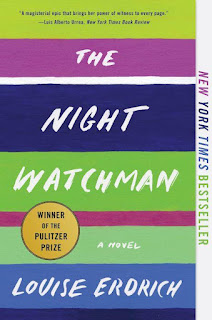
The Night Watchman, by Louise Erdrich: Poetic and Powerful

When an author as beloved as Louise Erdrich finally wins a Pulitzer, you read the book. You just do. But honestly, I put it off for a long time, and approached reading The Night Watchman like homework — something I felt like I should do, rather than something I really wanted to do. 

Erdrich quickly changed my mind. I was surprised how drawn I became to this book after only a few pages. Poetic and powerful, this is a fictional account of Erdrich's grandfather who fought to prevent the "termination" of North Dakota's Turtle Mountain Chippewas in 1952-53. A bill in Congress by a racist Mormon Senator sought to relocate them from their reservation and "reintegrate" or "assimilate" them into American society. "This new bill is about the worst thing for Indians to come down the pike," Erdrich's grandfather wrote in a letter, reproduced in the novel.

The novel is also the story of Patrice, a young woman who works at a factory on the reservation. Her story is about colliding with a changing world, looking for better opportunities, but still being comfortable with her heritage. Early in the story, Patrice has to travel to the Twin Cities to search for her sister Vera, who has disappeared. It's the first time Patrice has ever travelled, and been in a city, and it's eye-opening to her, but not necessarily in a good way.

For historical fiction, this is a surprisingly fluid, fast read. And I learned much. Very glad I read it.

Impressive side note: Erdrich is one of a handful of writers (I think just Philip Roth and John Updike are the other two, but I can't find a good source to confirm this) to win the hat-trick of major literary awards: Pulitzer (for this novel), the National Book Critics Circle Award (for LaRose), and the National Book Award (for The Round House). If you've never read her, this might be a good introduction to her fiction.

Friday, February 4, 2022

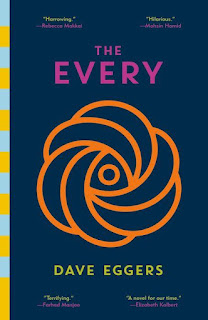
The Every, by Dave Eggers: The Tyranny of Choice

It's surely admirable that Dave Eggers isn't allowing his new novel to be sold on "the jungle," as he winkingly refers to Amazon in The Every. But unfortunately, the novel itself isn't nearly as good as his intentions. The Every is a sequel to Eggers' 2013 novel, The Circle —it actually feels like the second in a trilogy and has some serious Empire Strikes Back vibes. Here, the bad guys in the form of the evil tech company are winning. 

It's a few years in the future from the events of The Circle, and Eggers' Circle protagonist, Mae Holland, is now the CEO of the Every, which is a combination of the Circle and the newly acquired jungle. Our protagonist is a young woman from Idaho named Delaney, who together with her friend Wes, get jobs at The Every. But ever since Delaney recovered from a nasty screen addiction as a little girl, and "the jungle" destroyed her parents' grocery store, she's been hellbent on revenge against the evil tech company. 

Her plan is to destroy The Every from the inside out by introducing ridiculous idea after ridiculous idea until the public finally pushes back against the all-powerful tech company. Never mind that this premise, even for a satire, is patently silly, but my real beef is that the novel sort of just devolves into descriptions of these apps, and what happens when they're released into the wild. It just reads like a litany of bad ideas. For instance, Friendy is an app that allow you to gauge how good your friends really are by judging if they're being truthful to you in conversations, how much interaction you have with them, how emotionally fulfilling that interaction is, etc. Or OwnSelf, that tells you exactly when and for how long you should exercise, drink water, call you children, laugh, send out The Every's version of social media likes, and many more — basically controlling your entire life. And there are many, many more examples like this. 

Though it is a bit clumsy in its execution, and therefore doesn't quite work as satire, The Every is still an effective cautionary tale. Eggers hits on many of the same issues as in The Circle about the dangers of screen addiction, voluntarily relinquishing privacy, and choice. Of course, we all know that "slippery slope" is a logical fallacy. But slippery slope is also fertile ground for good satire. And though this isn't exactly good satire, the points are still well made. One of the main dangers introduced here is what happens when humans get lazy enough that they actually don't want choice. They want to be told want to do, have their lives planned out. The Every jumps on this notion and tries to pick the winners and losers. "Limitless choice is killing the world," one characters tells another.

The Every is also a novel about the dangers of group-think. Remember during 2016 how we just kept thinking the next horrific thing that presidential candidate said or did would be the one that finally caused his cult-like supporters to wise up and turn on him...but it never happened? That's what this novel is about too: Nothing is a bridge too far when it comes to group-think. 

On the plus side, I'll say this: Eggers is still very cool. There are several set pieces in this novel that had me howling — as on example, Delaney has to plan a "field trip" as a sort of welcome exercise. People keep asking the same questions over and over again, and are worried about the most ridiculous things. And then they all try to one-up each other in their outrage. It kind of reminded me of a neighborhood message board.

But these moments are too few, and The Every never really gains its footing like The Circle did, which felt clever and urgent. Often, The Every feels just ridiculous and too over-the-top. And it's also waaay too long. Eggers even makes a joke about how all novels should be fewer than 500 pages, and the absolutely limit of a reader's attention is 577, which is the exact folio count of The Every. But I'd humbly suggest The Every probably 177 pages too long. 

So even though I didn't think this was as successful as its predecessor, I'm hopeful for a satisfying Return-of-the-Jedi-esque conclusion to this trilogy. Eggers is still one of my favorites and I'll still read anything he writes. His heart is usually in the right place. And he usually and consistently makes me laugh, even if sometimes it's because it's ridiculous.

Wednesday, February 2, 2022

These Precious Days, by Ann Patchett: A Near-Perfect Essay Collection

Ann Patchett is one of my all-time favorite writers, mainly because she writes with amazing warmth. It's her superpower, and she brings it to bear clearly in her new essay collection, These Precious Days. 

Patchett explains in the introduction why she wrote essays during the pandemic, instead of fiction: Fear of death. She says while writing any novel, she considers what would happen to her fictional universe and all her beloved characters if she dies before it's finished. They would be wiped out too, and you get the sense she considers this the greater tragedy. And so she couldn't focus on writing fiction during the pandemic because "What was the point of starting if I wasn't going to be around to finish?" She mentions she wasn't more afraid of dying during the pandemic than any other time, but that during the writing all her novels, thoughts of death were nearly constant. 

But essays? "Death has no interest in essays," she says. And so we're all the luckier for it that she wrote these wonderful pieces during the pandemic. Each one is smart and funny and sincere and just generally a joy to read. There's not a dud in the bunch, a nearly impossible trick to pull off in an essay collection. Most essay collections are just that: a collection of disconnected pieces that appeared elsewhere and are published together to make a buck. But these feel intentional and thematically connected. Which, to use a tired cliche, means we get a book that is greater than the sum of its parts.

My favorite in the collection is an essay titled "There Are No Children Here." It's a series of 20-some vignettes all about Patchett's decision not to have children. I loved this piece for its gentle (and sometimes not-so-gentle) chiding of people who are always up in her business, asking her why, or suggesting she's missing something, or are in disbelief someone would consciously make that choice. She explains why she thinks people interpret her choice as a value judgment on theirs, as if both choices aren't equally valid. When someone knows you've purposely chosen not to have children, they sometimes see that as looking down your nose at their own decisions, because something that's not important to you is to them. Of course that's not the case (well, usually). Patchett writes that she thinks about this the same way as her choice not to eat meat or drink. When someone asks her if she minds if they order a cheeseburger, she says "Not unless you're going to make me eat it." Live and let live, basically.

The title essay These Precious Days is another highlight. It's about how she picked up Tom Hanks' story collection in the middle of the night, and through a series of very fortunate events, wound up with Hanks' personal assistant Sooki as her long-term houseguest during the pandemic. But Sooki became way more than just a houseguest, she became a dear friend. And they spent much of the early days of the pandemic together, as Sooki was undergoing cancer treatments in Nashville, and they are both just trying to figure out how to live in a new reality. 

Without exaggeration, I can faithfully say that this is one of the best essay collections I've ever read. Honestly. I loved this book a wholly indecent amount. Many of these essays are less than 10 pages, and I'd read one or two per day, always looking forward to taking a break from what I was doing and giving myself an Ann Patchett Essay Treat throughout the day. I can't recommend this more highly. 

Thursday, January 20, 2022

Olga Dies Dreaming, by Xóchitl González: An Incredibly Accomplished Debut

Olga Dies Dreaming, by Xóchitl González, is one of the best, most accomplished debut novels I've read in a long time. This book is just full of surprises, which is somewhat ironic given that it's about a wedding planner for the rich in NYC, to whom surprises are anathema. 

It's a novel that starts out like a frothy story about trying to fit in with NYC's upper crust. But as we learn more about Olga, her Congressman older brother Prieto, and their mother, the novels shifts in tone and takes on a much more political, and frankly, flat-out furious, tone. It becomes a novel about gentrification, class and race, the injustices wrought upon Puerto Rico (Olga and her brother are second-generation Puerto Ricans), neo-colonialism, corruption, and the failures of leadership. That's a pretty heavy shift from a light-hearted rom-com. But it truly works. And it's amazingly well done. 

Think about it in terms of napkins. The novel begins with Olga planning a wedding and explaining how every mother-of-the-bride has one detail Olga knows will be the bane of her existence during the wedding planning process. For this particular wedding, it's the napkins. But as you continue to progress through the book (and progress quickly, you will!), when you think about the napkins anecdote, it's a perfect symbol of the absurdity of what matters to the wealthy that doesn't really matter and at all, and it's a perfect juxtaposition to everything else in the novel that's so much more important. 

Here's a little on the plot: It's the summer of 2017, and we're all starting to figure out that the new "president" is going to be even worse than we could've possible imagined. But this is all in the background for the time being as Olga, born and raised in the Latinx-majority Sunset Park neighborhood of Brooklyn, hob-nobs with the rich and famous, sleeps with rich married men, appears on television shows to talk about weddings, and builds her wedding-planning brand. Her older brother Prieto is the Congressman for their district, and though the two siblings are close, we soon learn Prieto harbors some serious secrets. 

And there's one more twist before things really start to heat up: Their mother, a political radical and advocate for Puerto Rican independence, had left the family when they were kids. Not long after, their father falls apart, becomes addicted to drugs, and dies of AIDS. Their mother has been in contact with them throughout their lives through a series of letters. Somehow, she always knows what's going on in their lives: And she's very disappointed in Olga's career choice. 

So late in that summer of 2017, Hurricane Irma hits in the Caribbean, knocking out power to most of Puerto Rico. But if you remember, this was just the dress rehearsal for Hurricane Maria, which hit two weeks later, and absolutely devastated the island. The island got almost no help from the federal government to prepare or in the immediate aftermath. It was in many ways worse than Hurricane Katrina. (You may remember that video of the "president" chucking rolls of paper tolls into a crowd of people, people who had no food or clean water.)

Hurricane Maria becomes the fulcrum point for the novel. It's also a major turning point for both Prieto and Olga. Everything changes for them. For the better? Worse? What lessons do these characters learn? What happens with their mother?

I read this novel — it's just shy of 400 pages — in three days. I could not put it down. It's absolutely riveting, incredibly well-written, smart, and at times really funny. It's one of those novels that comes along only a couple times a year that really reminds me how much I love reading. I can't recommend it more highly.